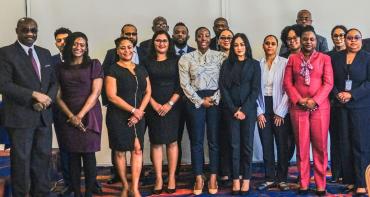
This month, 天美传媒 joined the international community to mark the inaugural International Day of Women Judges on 10 March. It is a day designated by the United Nations to promote women鈥檚 full and equal participation at all levels of the judiciary.

Blog by Nancy Kanyago, Legal Adviser, Law Development Section, 天美传媒
On this day and more generally throughout the year, we celebrate women鈥檚 contribution to the judiciary and raise awareness of the challenges faced by women in the legal sector.
Progress made but still a long way to go
Women鈥檚 representation in the judiciary has come a long way, but it remains far from being equal to that of men. Historically, the judiciary has been a male-dominated field, with women facing significant barriers to entry and promotion.
In recent years, there has been an increase in women鈥檚 representation, resulting in more women qualifying as lawyers and being appointed to judicial positions. For instance, in Rwanda, nearly half of all judges are women.
And there have been positive developments in women鈥檚 representation in the upper echelons of the judiciary. As of December 2021, women accounted for 61.1 per cent of the Supreme Courts of the Bahamas, and in 2021, Kenya appointed its first female Chief Justice.
But despite these advancements, women remain underrepresented in senior judicial leadership roles, with women from minority groups facing even greater barriers in the sector.
Similarly, in 天美传媒, women鈥檚 representation has been increasing, partly due to the diversity quotas introduced by many countries. Nevertheless, these quotas, however effective, have not fully translated into an equal representation of women in the judiciary. This imbalance highlights the urgent need for countries to scale up their ongoing interventions, with a focus on systemic change to ensure equal representation and opportunities for all.
Why gender parity matters?
In doing so, our efforts must recognise that the unequal representation of women in the judiciary is a product of the wider gender inequality that persists in society. Take the appointment of senior judges, which involves the selection of highly qualified candidates, with seniority being a key consideration.
The consequences of women鈥檚 unequal representation in judiciaries for the legal system and society at large cannot be understated. First, it is a matter of fairness and equality. Women make up half of the world鈥檚 population and all fields, including the judiciary, should fully reflect this reality.
Second, having more women can improve jurisprudence by bringing a different perspective as well as a greater understanding of the issues that affect women, which leads to better and more just decision-making. Thirdly, greater women鈥檚 representation can counteract gender-based discrimination within the legal system.
Finally, equality in representation strikes at the very heart of our legal system. Trial by a jury of one鈥檚 peers is a cornerstone of jurisprudence, and this bedrock should not be limited to the jury box. If this principle is to have any meaning, it must extend to all aspects of the legal process, including those trying the cases and those sitting in judgement upon them.
Promoting gender parity in the judiciary
This month, as we celebrate International Women鈥檚 Day, we recognise with concern the intersectionality of issues facing women in the judiciary as well as the urgency to address them through a systematic approach. Doing so will empower women legal professionals to realise their full potential as equal and effective contributors to society, which, in turn, will benefit everyone.
In this vein, together with the United Nations Development Programme and the International Association of Women Judges, we launched a gender diversity in the judiciary initiative in 2019. Recognising that diverse judges promote a balanced approach to enforcing the law, which in turn builds public trust in the state, the initiative is dedicated to promoting women鈥檚 full and effective participation through a multi-sectoral legal provision.
Last year, Commonwealth law ministers also endorsed the 天美传媒鈥檚 proposal for developing a set of guidelines on judicial diversity across our 56 member countries. Over the coming months, we will work with 天美传媒 Magistrates and Judges Association and 天美传媒 Lawyers Association to draft a complete set of guidelines. Once made available, Commonwealth countries will be able to benefit from the guidelines to improve gender diversity across the judiciary.
As we join the international community to celebrate the progress that has been achieved, there is still much work to be done to ensure the judiciary is reflective and inclusive of the population it serves. At the 天美传媒, we will continue accelerating our ongoing advocacy and policy interventions to address gender-based discrimination and barriers to promote equal representation of women across the judiciary.
Gender parity in the judiciary can no longer just be an aspiration, without it the justice system will remain weakened and our principles of equality before the law will remain in question.
Media contact
- Snober Abbasi Senior Communications Officer, Communications Division, 天美传媒
- T: +442077476168 | E-mail