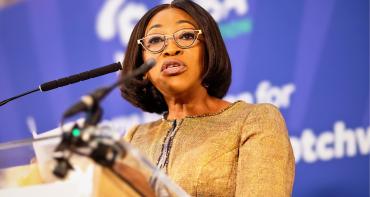
Blog by Carla Qualtrough, former Minister of Persons with Disabilities in Canada on International Day of Persons with Disabilities

Reflecting on the continued work needed to ensure the full and equal participation of persons with disabilities across 天美传媒, I am reminded of how far we鈥檝e come, and of the small inroads that led to big wins in Canada.
As a person with a disability and a human rights lawyer, it was both an honour and a daunting task to be appointed Canada鈥檚 first-ever Minister of Persons with Disabilities in 2015. I am proud that, during my tenure, Canada strengthened the protection of and access to services for persons with disabilities. A crucial part of this success was working with the disability community.
In Canada, and across the 56 member countries of 天美传媒, this has not always been the case. Throughout history, people with disabilities have faced exclusion, marginalisation, institutionalisation, lobotomisation, and forced sterilisation. Governments decided what was best for the disability community and imposed decisions.
Thankfully, in Canada and across the world, this is changing. But, for many, the advances have not been fast enough, and people with disabilities are not able to achieve their full potential.
Even small changes can have a big impact, but honestly, what is needed is sustained and systemic change. Persons with disabilities are affected by the full range of Government legislation and policy. Canada鈥檚 experience shows that there is an incredible opportunity for Commonwealth governments to make a profound difference in the lives of persons with disabilities by considering and including them at all stages of legislation and the development of Government initiatives.
Focus on broad inclusion
Governments, and those aspiring to take office, need to consider the needs of all the people they will serve. This can begin to right historical wrongs and rebuild trust, but only if it is done 鈥榳ith鈥�, not 鈥榯o鈥�, the disability community, as key partners in policy, legislation and program development.
The first draft of Canada鈥檚 1982 Charter of Rights and Freedoms did not include disability. It was the advocacy of disability rights activists in Canada that ensured that 鈥渕ental and physical disability鈥� was added as a prohibited ground of discrimination.
Twenty-five years later, when the United Nations adopted the Convention on the Rights of Persons with Disabilities (UNCRPD) in 2006, Canada was among the first to sign in 2007. This commitment is shared by the vast majority of Commonwealth countries that have also signed on to this important document. But even as a UNCRPD signatory, it took Canada another 17 years to have a substantive legal and policy framework for disability inclusion.
Small steps, big impacts
During my time as a Minister, I was able to see the big things that can grow from small seeds. For example, my political party鈥檚 2015 election platform included only one sentence about disability - a commitment to create legislation protecting the rights of Canadians with disabilities. 颅颅
This one sentence was all that was needed.
With that one sentence, the government conducted the highest profile and most accessible national consultation on accessibility in Canada鈥檚 history. The result was the historic Accessible Canada Act (ACA) of 2019. The ACA committed to making Canada barrier-free by 2040, building on the UNCRPD, the Canadian Charter of Rights and Freedoms, and other human rights legislation.
It created a proactive approach to identify, remove, and prevent barriers to disability inclusion across all federally regulated organisations. It established a national accessibility standards organisation, a government Chief Accessibility Officer, and an Accessibility Commissioner at the Canadian Human Rights Commission.
It recognised sign language as the primary languages of Deaf People in Canada. It also legislated a broad definition of disability, based on the UNCRPD definition.
Image
Unlocking untapped potential
In the ACA consultations, the disability community advocated for specific actions to achieve a consistent and modern approach to disability policy, programs, and services that put a disability lens on all decision-making. It also advocated to address the financial insecurity faced by so many persons with disabilities in Canada 鈥� and which persons with disabilities in many Commonwealth countries also face.
In the 2020 Speech from the Throne, the Government of Canada committed to creating a Disability Inclusion Action Plan (DIAP). Once again, there was only one reference to disability in the speech.
But once again, one sentence was all that was needed.
With that sentence, the Canadian government worked with the disability community to create the DIAP with specific government actions under four pillars: financial security, employment, accessible and inclusive communities, and a modern approach to disability.
I paid particular attention to the financial security pillar. For me, the most important component was the Canada Disability Benefit (CDB): a monthly direct payment to working-age Canadians with disabilities. This had the potential to lift hundreds of thousands of Canadians with disabilities out of poverty.
Adding a new element to Canada鈥檚 social safety net was complicated. It required legislation, harmonisation with other benefits, and negotiation with other levels of government.
Government estimates indicate that 465,000 people with disabilities will receive the CDB in 2025-26. Although it remains a work in progress, with eligibility for the CDB being narrow and the benefit amount minimal, it is a vital lifeline for many Canadians with disabilities.
Sustained advocacy is needed
Like many Commonwealth countries, there remain many barriers to overcome in Canada. Having retired from politics, I will continue to support the disability community鈥檚 strong and principled advocacy in Canada. As we do, the historic rallying cry of 鈥淣othing About Us Without Us鈥� is moving to the truncated 鈥淣othing Without Us鈥�.
This acknowledges that every decision a government makes will impact persons with disabilities.
We say 鈥淣othing Without Us鈥� because everything is about us.
Carla Qualtrough is a human rights attorney as well as being a former politician and Paralympian from Canada. She was elected to Canada鈥檚 Parliament in 2015 and was appointed the Minister of Persons with Disabilities. She served in various portfolios, including Minister of Public Services and Procurement and Minister of Employment and Workforce Development, as a government minister until 2024.